Purpose
An update to the 2010 Clinical guidelines on the diagnosis and treatment of Uncomplicated Cystitis and Pyelonephritis will begin in 2019. For this update of the UTI guidelines, we propose to expand the scope to community-acquired urinary tract infections, both complicated and uncomplicated. We will be using GRADE methodology to assess the quality of published evidence.
For this update, IDSA is looking for an
ID Pharmacist to serve on the panel. For more information on the guideline process and requirements, please see below.
Responsibilities
- Help select the final scope of the guidelines
- Help identify the most important and relevant clinical questions
- Help frame clinical questions in PICO format
- Assist in the selection of patient-important outcomes
- Guide the review of literature and assessment of the literature
- Help develop recommendations
- Assist in drafting the manuscript
- Participate in and adhere to the principles of IDSA-provided formal training on guideline development
- Comply with the IDSA Handbook for Development of Clinical Practice Guidelines
- Participate in monthly calls
- Attend one in-person meeting per year
Ideal Qualifications
- Pharmacist/Pharmacology expert
- Expertise in the management of UTI
- Extensive knowledge and experience in the management of a clinical practice, ideally in both academic and private practice settings
- Familiarity with clinical practice guidelines, their development using evidence-based medicine, and implementation into clinical practice
- A commitment to adhere to the GRADE methodology and the guideline development timeline (see here for more information: https://www.idsociety.org/practice-guideline/clinical-practice-guidelines-development-training-and-resources/)
- Good organizational skills and attention to detail
- Relevant experience and/or published literature related to the guideline topic
Requirements to Apply
Guideline Development Timeline
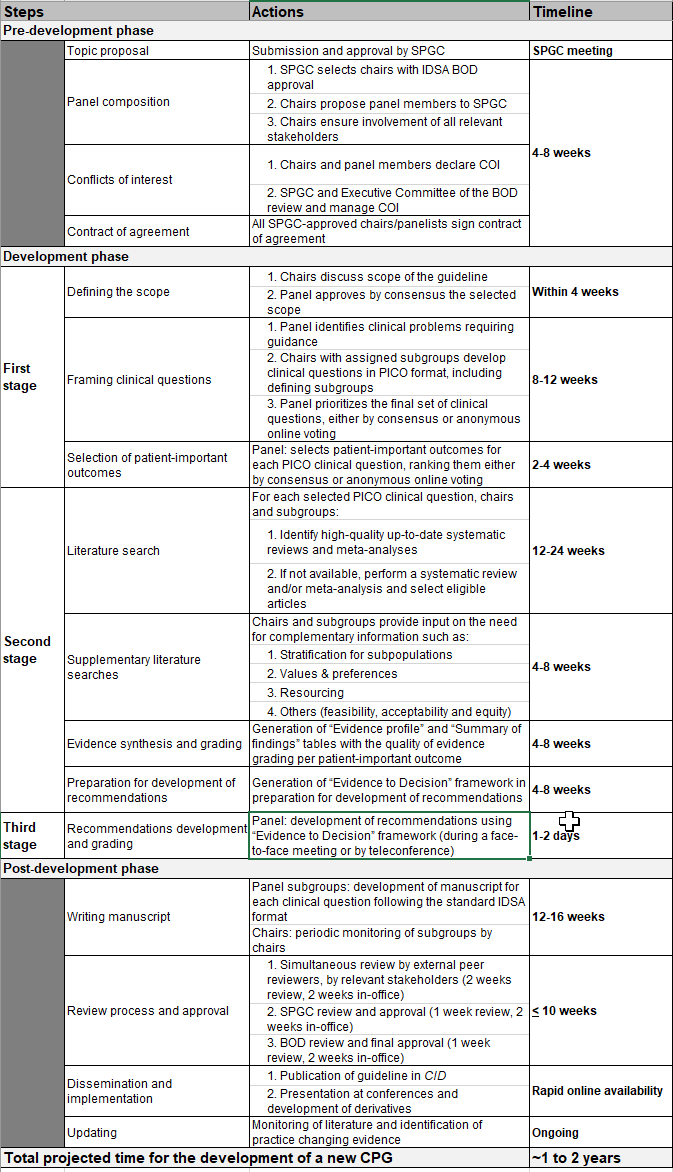
Meeting Frequency
Meeting Frequency Meetings to be held at least once a month, as needed, by phone/webinar. Panel members will be asked to respond to email communications on a regular basis at all stages of the guideline development process.
Estimated Time Commitment
2-4 hours per month; time commitments will vary depending on the stage of guideline development. Once or twice a year, panel members will meet face-to-face (2-3 hours at
IDWeek and/or 6-8 hours for a full day meeting).
Appointment
The panel Co-Chairs will identify prospective panel members, which will be reviewed and approved by the SPGC chair and Board Liaison. Participation on the guideline panel will only be confirmed following review of potential conflicts of interest.